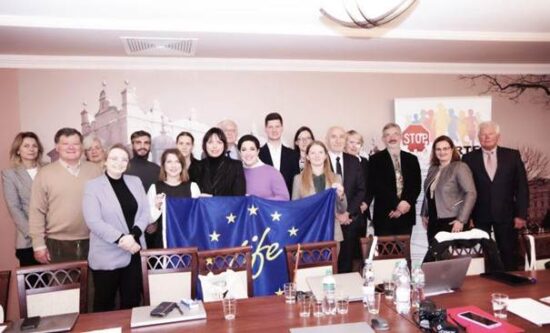


CAMERINO – It’s called Life Mercury Free, and is coordinated by Professor Roberta Censi of the School of Pharmaceutical Sciences and Health Products. The university has extensively engaged the local area through surveys and collaborations with institutions, associations, and schools.
7th October 2025
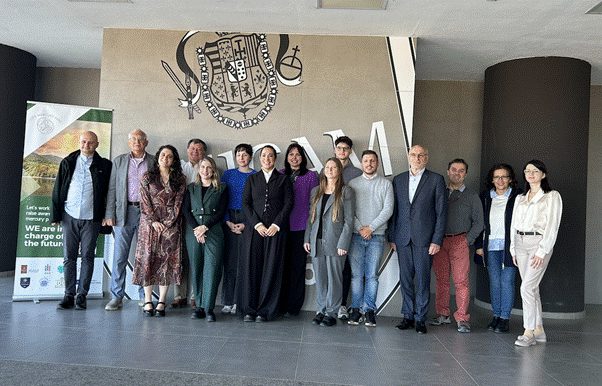
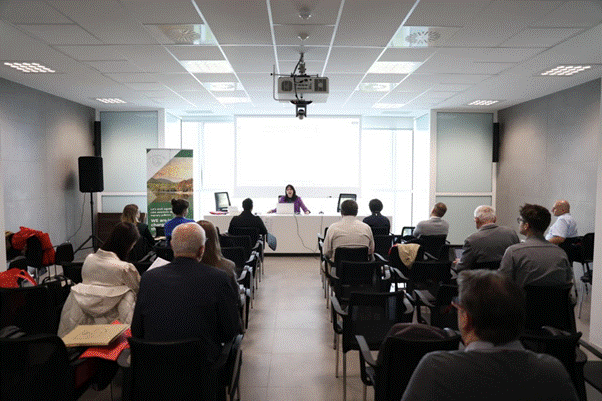
The final meeting of the European project Life Mercury-Free, coordinated by Professor Roberta Censi of the School of Pharmaceutical Sciences and Health Products, took place at the University of Camerino. Over the past three years, Unicam has played a leading role in raising public awareness about the use and proper disposal of mercury-containing products.
Thanks to surveys, events, and collaborations with local authorities, schools, associations, and NGOs, the university has been able to engage the community extensively, gaining numerous supporters and launching a process that paves the way for future public engagement initiatives involving other heavy metals.
During the morning, the official guide compiled by the consortium members, containing five best practice manuals, was presented.
“The choice of Camerino as the venue for the final meeting,” stated Roberta Censi, “confirms Unicam’s strategic role, not only as a place to share the results achieved, but also as a laboratory of ideas for outlining new research and awareness-raising perspectives beyond the mercury issue.”
The Life Mercury-Free project has, in fact, drawn attention to an often underestimated problem: environmental contamination by mercury resulting from the use and improper disposal of obsolete but still common everyday objects, such as batteries, light bulbs, thermometers and sphygmomanometers.
Through communication and dissemination activities, including digital information platforms, international marathons, and Summer Schools, the project aimed to raise awareness among civil society, the scientific community, and institutions, fostering awareness, changing habits, and disseminating good waste management practices. The expected medium- and long-term impact is to reduce mercury contamination and improve the health and well-being of citizens.
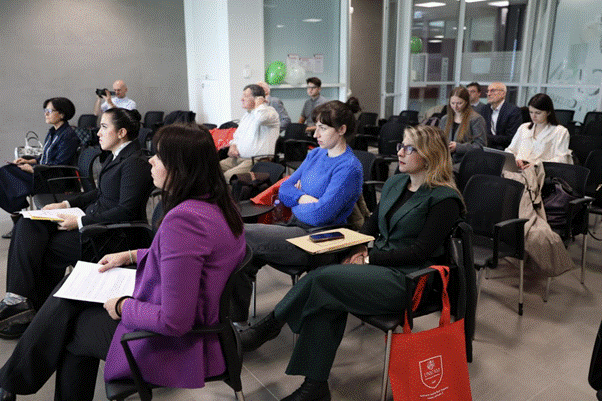
In addition to Unicam, European and international research institutes and companies took part in the project: the project coordinator, Lodz University in Poland, the Akademia Gorniczo-Hutnicza Im. Stanislawa Staszica W in Krakow, also in Poland, the University of Evora in Portugal, the Lviv Polytechnic National University and the Ivano-Frankivsk Academy of Ivan Zolotoustoy University in Ukraine, and Innovation Hive in Greece.
“Participation in the project,” added Cristina Casadidio, a member of the research group, “has strengthened Unicam’s ability to collaborate with international partners, consolidating the University’s role as a benchmark for scientific innovation and social responsibility.”
The team of Unicam researchers involved includes, in addition to Professors Roberta Censi and Cristina Casadidio of the School of Pharmaceutical Sciences and Health Products, Rita Giovannetti, Marco Zannotti, and Stefano Ferraro of the School of Science and Technology.
Courtesy: Cronache Maceratesi®